Call me naïve. No, really -- go ahead and call me naïve.
But I think our society's unique maladies and general loneliness are closely linked to our departure from the back-breaking acts of growing and making food, raising children, and making the things we need with our own hands. Yes, of course I realize that the industrial revolution has made life a lot more livable for everybody, especially the poor. And this is the point at which you might want to call me naïve, reminding me that if I had to make my own bread and my own cheese, and if I had to grow all my own food and live at the mercy of droughts and floods, I would feel very differently about such things.
I don't doubt it, and I probably am being naïve. It's awfully cheeky of me as an affluent Westerner to idealize subsistence farming -- of course "getting back to the land" sounds wonderful when you have all the options in the world.
Nevertheless, I believe that gardening, baking bread, attending to children, washing diapers, making cheese, building furniture -- the things we used to do with our hands but now delegate to other people and companies and machines -- I believe that these activities feed us in ways our society never realized. And now that all our stock is in efficiency, ease, and quantity, it's nearly impossible for us to return to a lifestyle that asks so much of us, body and soul.
We're lazy now. We've separated ourselves so much from the back-breaking toil that our great-great grandparents knew. And really, you can't blame them for trying to make life easier, can you? It was hard. But there are a few things that they didn't count on. Like that the hard work of making a life was good for the soul. There are lots of studies out there these days about how therapeutic these activities can be, and more and more people are "discovering" the joy of getting their hands dirty.
I'm one of them, I guess. And it may be naïve -- or even arrogant -- of me, but I think that hard work does a body (and a soul) good.
Showing posts with label essays. Show all posts
Showing posts with label essays. Show all posts
Monday, April 06, 2009


Wednesday, July 16, 2008
Making room for food
I don’t know if I can shop at the grocery store anymore. It’s been a several-year-long process, so this supermarket aversion hasn’t come as a complete shock. But with my current lifestyle, it doesn’t make things very easy, either.
But then, ease is probably what created the supermarkets and the food industry that stocks them and our culture’s perceived need for this time-saving, cost-saving middleman. Ease needs to be shifted down a few rungs on my food priority list.
Mr. Incredible, who has a five-ingredients-or-fewer rule when it comes to bread, joins me in this quest to find and buy food that nourishes and delights—but that doesn’t completely break the bank. Which is more and more of a problem considering the way food prices are rising these days.
Nevertheless, we’re determined in our household to make time to shop for, prepare, and savor healthy, tasty food. And as much as possible, we’ll find room in our budget for good food, too.
People at work are always asking me how I manage to bring in healthy leftovers each day, when they eat out for lunch three to four days a week. My answer? Sometimes, cooking is all I get done in an evening. Meaning I don’t necessarily have their social life or keep up with the TV lineup like they do.
Take tonight, for instance: there’s red lentil and cauliflower coconut curry to prepare (the cauliflower and cabbage must be used ASAP!) and then I’ll have to get a head start on the cottage pie I’m preparing for dinner at a friend’s house tomorrow (there’s no way I’d be able to get it done tomorrow between work and the time we have to leave). Just like in college, when I would gear myself up for a late night of paper-writing, I prepare myself mentally to devote the larger portion of my evening to food. And surprising as it may seem, I rarely regret these cooking marathons. (I just have to remember to drink a lot of water and sit down while I chop these days, otherwise my pregnant back and feet will regret it tomorrow.)
So what’s the problem with the supermarket and why can’t I just buy healthy, yummy stuff there? They do carry produce, after all.
Most of the products at the store are highly processed, something that I’m becoming more and more aware of as I read more labels, and I’m just not sure if this frankenfood is good for me. Even foods that seem fairly straightforward and pure are messed with; that is, they have additives and conditioners and dyes and preservatives (not to mention residual pesticides and antibiotics)—all kinds of things that would be absent if I prepared these foods myself at home.
Even the produce is making me wary. Grocery store tomatoes are the perfect example of produce that’s made for easy transportation and long shelf life, apparently without much thought to taste (or nutrition, actually).
There are a lot of people to blame for my supermarket frustrations: there’s me, of course—the compulsive label reader and lover of really good-tasting, fresh food. And there’s the delicious legacy of our families’ home gardens and family meals. But then there’s also Barbara Kingsolver, whose book, Animal, Vegetable, Miracle has made me a believer in eating close to home, for reasons that range from nutrition to family life to economics. And this summer, Michael Pollan has caused me a great deal of irritation as I browse the supermarket shelves and see so-called health claims calling to me from foods that may not even be food, let alone healthy. His book In Defense of Food has been a daily source of discussion in our household for its critical view of what most of us has accepted as nutrition.
But this awakening has caused me more than just frustration. It’s also caused me to see my food as more than fuel. I’ve been pushed to reevaluate my priorities and decide just how much organic local potatoes and free-range eggs mean to me and the health of my family. As it turns out, they mean quite a lot; I just have to decide what to cut out of my life now in order to make room for them. And I’ve been reminded that food is more than just its nutrients. Really good food—really well prepared—constitutes a social event, an act of gratitude toward God and his creation, and a labor of love.
And when you think of it that way, suddenly the supermarket doesn’t seem so super.
By the way, if you're still looking for something to read this summer, I highly recommend both of the books below.


But then, ease is probably what created the supermarkets and the food industry that stocks them and our culture’s perceived need for this time-saving, cost-saving middleman. Ease needs to be shifted down a few rungs on my food priority list.
Mr. Incredible, who has a five-ingredients-or-fewer rule when it comes to bread, joins me in this quest to find and buy food that nourishes and delights—but that doesn’t completely break the bank. Which is more and more of a problem considering the way food prices are rising these days.
Nevertheless, we’re determined in our household to make time to shop for, prepare, and savor healthy, tasty food. And as much as possible, we’ll find room in our budget for good food, too.
People at work are always asking me how I manage to bring in healthy leftovers each day, when they eat out for lunch three to four days a week. My answer? Sometimes, cooking is all I get done in an evening. Meaning I don’t necessarily have their social life or keep up with the TV lineup like they do.
Take tonight, for instance: there’s red lentil and cauliflower coconut curry to prepare (the cauliflower and cabbage must be used ASAP!) and then I’ll have to get a head start on the cottage pie I’m preparing for dinner at a friend’s house tomorrow (there’s no way I’d be able to get it done tomorrow between work and the time we have to leave). Just like in college, when I would gear myself up for a late night of paper-writing, I prepare myself mentally to devote the larger portion of my evening to food. And surprising as it may seem, I rarely regret these cooking marathons. (I just have to remember to drink a lot of water and sit down while I chop these days, otherwise my pregnant back and feet will regret it tomorrow.)
So what’s the problem with the supermarket and why can’t I just buy healthy, yummy stuff there? They do carry produce, after all.
Most of the products at the store are highly processed, something that I’m becoming more and more aware of as I read more labels, and I’m just not sure if this frankenfood is good for me. Even foods that seem fairly straightforward and pure are messed with; that is, they have additives and conditioners and dyes and preservatives (not to mention residual pesticides and antibiotics)—all kinds of things that would be absent if I prepared these foods myself at home.
Even the produce is making me wary. Grocery store tomatoes are the perfect example of produce that’s made for easy transportation and long shelf life, apparently without much thought to taste (or nutrition, actually).
There are a lot of people to blame for my supermarket frustrations: there’s me, of course—the compulsive label reader and lover of really good-tasting, fresh food. And there’s the delicious legacy of our families’ home gardens and family meals. But then there’s also Barbara Kingsolver, whose book, Animal, Vegetable, Miracle has made me a believer in eating close to home, for reasons that range from nutrition to family life to economics. And this summer, Michael Pollan has caused me a great deal of irritation as I browse the supermarket shelves and see so-called health claims calling to me from foods that may not even be food, let alone healthy. His book In Defense of Food has been a daily source of discussion in our household for its critical view of what most of us has accepted as nutrition.
But this awakening has caused me more than just frustration. It’s also caused me to see my food as more than fuel. I’ve been pushed to reevaluate my priorities and decide just how much organic local potatoes and free-range eggs mean to me and the health of my family. As it turns out, they mean quite a lot; I just have to decide what to cut out of my life now in order to make room for them. And I’ve been reminded that food is more than just its nutrients. Really good food—really well prepared—constitutes a social event, an act of gratitude toward God and his creation, and a labor of love.
And when you think of it that way, suddenly the supermarket doesn’t seem so super.
-----
By the way, if you're still looking for something to read this summer, I highly recommend both of the books below.
Monday, April 21, 2008
Juxtaposition
We country folk tend to think that there is no wildlife in the city (except, of course, for pigeons, squirrels and rabbits and they don’t count because people feed them processed, greasy food in the park—they’re just mooching off the urban system). But as I write this, an immense bird is soaring between skyscrapers, diving then recovering altitude and swooshing past the office windows, barely missing the cold, hard steel of our building with its daring wings. As I look out again, I see that there are now several hawks (at least, I think they are hawks) soaring through this part of downtown.
Just this morning a fellow bus rider, who lives in the neighborhood of Morningside, informed me he had deer in his backyard this morning, and last fall Mr. Incredible and Lewis caught a long glimpse of a beautiful buck in our neighborhood. (In fact, deer present quite a problem for the City ofPittsburgh
Just this morning a fellow bus rider, who lives in the neighborhood of Morningside, informed me he had deer in his backyard this morning, and last fall Mr. Incredible and Lewis caught a long glimpse of a beautiful buck in our neighborhood. (In fact, deer present quite a problem for the City of
Thursday, November 08, 2007
stress
n. — the condition that results when person-environment transactions lead the individual to perceive a discrepancy, whether real or not, between the demands of a situation and the resources of the person's biological, psychological or social systems."We talk a lot about stress in this culture. And because of us, other cultures are catching on, too—last year, my boss and I heard a story on NPR about the rise of see-tress—a phonetic approximation of the English word—in Vietnam, where business is good and stress is becoming a symbol of affluence, ambition, and success. [Last year, as a result of hearing this story on the radio, we ran an article in Seek magazine (PDF; see page 7) addressing the stress, and other North American cultural products, that are exported to the rest of the world with little thought to their effect on our global neighbors.]
—The Great Wiki
Lately I've been thinking about stress from this perspective, but also from the perspective of someone who's been feeling quite stressed out lately, and I think this link between stress and consumerism is stronger than most of us would ever expect.
Think about it: if stress is the result of a discrepancy between expectations and reality, or the demands and the resources to meet those demands, then the potential for stress will increase anytime expectations and demands increase, because there is always some limit to our resources.
Now you'd think—and I believe many of us North Americans do think—that, at some point, we would have enough time, money, energy, whatever, to meet the demands that we and others have placed on us; that we could reach a point where stress levels stop rising and reach a sort of equilibrium. But that's exactly the flawed thinking that gets us in trouble in the first place; it's based on consumerist thought that isn't really aware of itself. The trouble with humanity is that, the more we have, the more we want. We can make a conscious effort to exercise self-control, to say "enough is enough," to be content with what we have. But unless we do that, the demands and expectations will continue to rise. And with them come stress.
There's nothing wrong with expectations or ambitions. Heck, the whole reason we uprooted our entire lives three months ago and moved here to Pittsburgh—that was all about expectations and ambitions. Expectations for an education that would allow my husband to better use his gifts and talents. Ambitions for him to make more money so that I don't have to—especially while we're raising a family, which we hope to do soon. Expectations that someday, we can have more time to pour into our community, our church, our family, and our friends. There's nothing wrong with us working toward these goals. But we need to understand that, in the meantime, we are going to experience stress as a result.
The key, however, is to halt the escalation of consumerism. We need to know where to draw the line. Because if we don't draw that line (and keep retracing it as each day passes), when we arrive there, we'll soon find there's more that we aspire to; further discrepancies between what is and what we think should be.
This is all fairly obvious . . . but what I think we really don't get—what we just don't realize most of the time—is that we all must make a decision to be content. Contentment doesn't come to us; we come to it. And—although this is unthinkable to most of us—for the most part, our neighbors around the world who have a lot less than we do are much better at drawing that line and choosing contentment than we are. How can they be content with next to nothing, we wonder?
In large part, our society is populated by the descendants of hardworking, hungry, and sometimes even deprived, abused, or persecuted people. Now don't get me wrong; I'm glad all our ancestors had the ability and the drive to "make a better life" for their families . . . I just think sometimes we take that whole "making a better life" thing a little too far. Because often "a better life" is defined by possessions, higher education, and even higher expectations—not by deeper relationships with God, family, and friends, or by being a person of character. And you have to admit, by and large, we North Americans are quite poor in spirit, whereas our neighbors across the ocean tend to be a bit better at focusing on what's really important in life.
Maybe it's because they're not stressed out by the daily grind of reaching for more.
For the most part, our neighbors in Africa and Southeast Asia and South America don't get to choose where they "draw the line" with regard to what they're striving for. I suppose you could say they're lucky they don't have to make that decision. But in a way, they still do—we all do. We all have to determine what's enough and be content if we ever want to have less stress.
And I sure as heck have had enough of that for one lifetime. How about you?
Saturday, September 22, 2007
Realization
Have you ever learned something about yourself that you really never wanted to know?
And when my life experience and dreams don’t match up closely enough . . . that’s when I feel stressed. Well, that’s the definition of stress, isn’t it? The trouble is, I suppose, that I haven’t really learned the art of reconciling these two things—a skill that all spoiled children need to learn.
There are probably several ways to do this. Stoics like Mr. Wonderful may choose to have no expectations at all (at least that’s what he claims sometimes), while seriously nerdy overachiever types just try harder to “do it all” (yes, that would be more my personality). But if you think about it, neither of these approaches is really that effective. It’s neither feasible nor healthy to empty yourself of all dreams and aspirations, and try as I might, I can never live up to my own expectations. I may be smart and talented, but it doesn’t matter how hard I try; sometimes I just won’t succeed in the way I want to.
Over the past few months, despite the fact that I threw myself, body and soul, into the task of finding a job that would pay well and make the best use of my skills, I failed. It didn't matter if I stayed up another hour to search for more jobs, or if I revised my resume for the eighteenth time; I just couldn't do it. And now, take the house: I can't really work any harder to suddenly make this house beautiful and perfect and 100 percent guest-ready; these things just don't depend on me like I think they do.
Wednesday, September 12, 2007
September hope
There is something about these early autumn days that just invites dreams and wandering thoughts that have very few practical elements. Autumn is the season of renewed hope -- of gathering up all the pieces of your life and actually believing that something good could come of them.
It's not spring, by any means -- there is nothing poking up through the soil for the first time, and the pace of life is not quite so frantic or harsh as the rapid growth of spring. In early fall, the time for growth has come and gone, and some things haven't quite turned out like you thought they would. If spring is hopelessly, naively optimistic, then autumn is the season of mature hope, when you've seen hard times and know they will come again but you have renewed energy to press on in spite of the past. Failure and a general sense of doom may be looming in the distance, but autumn is the time for squinting at it from afar and saying to yourself, "I think I just might be able to beat this" -- whatever it is, it seems there's always something like that in my life come September.
This September, of course, there are a number of things -- among them, just surviving in this new environment. And so, on this sunny, cool afternoon that's driven me to sip steaming coffee and pull on a waffle-knit henley . . . I am staring down the loneliness, the financial discomfort, the frustration with the state of our house, the fear that I might keep worrying and hating myself for the rest of my life, the thought that this whole Pittsburgh experiment might just fail miserably . . . I am staring it all down from afar with that against-the-odds optimism, and thanking God for His renewing strength this September.
A random thought about music
I was listening to the radio today, and was again annoyed by the trend that music artists are taking to calling themselves by singularly band-like names. If you heard a song by Feist or Iron & Wine for the first time, would it be instantly obvious that these are individuals, rather than bands? And if you heard a song by Rilo Kiley, would you guess that Rilo Kiley is a band? Of course not! So why do they do it? I have a theory: they are setting us all up to be mocked and ridiculed by their nerdiest, most dedicated fans who laugh and say to each other, "ha ha, she doesn't even know that Rilo Kiley isn't a person; Rilo Kiley is a band!" Music artists like this are drawing boundary lines between "true" fans and casual listeners who aren't absolutely obsessed with them yet.
Now, I know what you're saying: "But Dulci, you like Sting." And for those of you who didn't know I like Sting, please don't feel like this has to come between us. I know most people don't like Sting, and that's O.K. -- I won't try to push old Police albums on you or anything. Anyway, I realize Sting is somewhat of an ambiguous title for an individual music artist. But there's a bit of a difference here; most people have no idea that Sting's real name is Gordon Matthew Thomas Sumner (I can see why he changed it -- Gord Sumner doesn't quite have the 80s rock appeal that Sting does). Whereas people like Leslie Feist have a sort of dual public identity; they have no qualms about telling people their real, full names, but on their albums, they go by their enigmatic stage name. See? There is a difference.
If you asked me to suggest an underlying social change that is contributing to this shift in the way that musicians refer to themselves, I could probably come up with some kind of B.S. about how today's artists are much more willing to openly admit that they lead a double life; that the person on stage and the person on the street are not the same by any means. But I'm afraid I'd have to do a great deal more research in order to really confirm that hypothesis, and like I said, it's B.S. anyway.
It's not spring, by any means -- there is nothing poking up through the soil for the first time, and the pace of life is not quite so frantic or harsh as the rapid growth of spring. In early fall, the time for growth has come and gone, and some things haven't quite turned out like you thought they would. If spring is hopelessly, naively optimistic, then autumn is the season of mature hope, when you've seen hard times and know they will come again but you have renewed energy to press on in spite of the past. Failure and a general sense of doom may be looming in the distance, but autumn is the time for squinting at it from afar and saying to yourself, "I think I just might be able to beat this" -- whatever it is, it seems there's always something like that in my life come September.
This September, of course, there are a number of things -- among them, just surviving in this new environment. And so, on this sunny, cool afternoon that's driven me to sip steaming coffee and pull on a waffle-knit henley . . . I am staring down the loneliness, the financial discomfort, the frustration with the state of our house, the fear that I might keep worrying and hating myself for the rest of my life, the thought that this whole Pittsburgh experiment might just fail miserably . . . I am staring it all down from afar with that against-the-odds optimism, and thanking God for His renewing strength this September.
A random thought about music
I was listening to the radio today, and was again annoyed by the trend that music artists are taking to calling themselves by singularly band-like names. If you heard a song by Feist or Iron & Wine for the first time, would it be instantly obvious that these are individuals, rather than bands? And if you heard a song by Rilo Kiley, would you guess that Rilo Kiley is a band? Of course not! So why do they do it? I have a theory: they are setting us all up to be mocked and ridiculed by their nerdiest, most dedicated fans who laugh and say to each other, "ha ha, she doesn't even know that Rilo Kiley isn't a person; Rilo Kiley is a band!" Music artists like this are drawing boundary lines between "true" fans and casual listeners who aren't absolutely obsessed with them yet.
Now, I know what you're saying: "But Dulci, you like Sting." And for those of you who didn't know I like Sting, please don't feel like this has to come between us. I know most people don't like Sting, and that's O.K. -- I won't try to push old Police albums on you or anything. Anyway, I realize Sting is somewhat of an ambiguous title for an individual music artist. But there's a bit of a difference here; most people have no idea that Sting's real name is Gordon Matthew Thomas Sumner (I can see why he changed it -- Gord Sumner doesn't quite have the 80s rock appeal that Sting does). Whereas people like Leslie Feist have a sort of dual public identity; they have no qualms about telling people their real, full names, but on their albums, they go by their enigmatic stage name. See? There is a difference.
If you asked me to suggest an underlying social change that is contributing to this shift in the way that musicians refer to themselves, I could probably come up with some kind of B.S. about how today's artists are much more willing to openly admit that they lead a double life; that the person on stage and the person on the street are not the same by any means. But I'm afraid I'd have to do a great deal more research in order to really confirm that hypothesis, and like I said, it's B.S. anyway.
Tuesday, January 30, 2007
Confessions of a workaholic
Since I've been such a crappy blogger of late, I thought I'd post this little piece, which I recently wrote for my church's newsletter.
My brothers, on the other hand, were first-rate frolickers. They made toys out of everything, and spent a good portion of their childhood laughing. As their overly serious older sister, I thought they were just wasting time. After all, I didn’t see grown-ups running around all day, wrestling and pretending they were cowboys.
And then I became a grown-up myself. My Anabaptist work ethic made it easy for me to succeed in college, and later, work situations. More than ever, fun and celebration seemed like an intrusion. If I was going to do something other than work—something I deemed “unproductive”—it should be a relaxing activity, something that would recharge my batteries for another day of work. But something was clearly missing: joy.
The Israelites don’t seem to share my problem with joy and celebration. Every time I read through the Old Testament, I’m surprised that such a creative and productive God would prescribe so many lengthy feasts and festivals. Surely God would not promote laziness and excess, I thought—but that’s exactly how these feasts seemed to me. Lots of people slacking off, eating gluttonous amounts, and . . . dancing? What a waste of time. What silliness! Besides, it’s not realistic for everyone to be celebrating at the same time; someone had to be working; otherwise, they would fall far behind on their tasks.
We modern-day North American Christians aren’t used to being told to rest, or feast, or celebrate. We set our own individual schedules, sleeping, eating, worshiping, and buying whenever it’s most convenient for us. But when the Israelites entered the Promised Land, God was surprisingly specific about how they ought to spend their time.
In Deuteronomy chapters 15–16, God establishes a rhythm of sacrifice, mercy, worship, celebration, and feasting in the lives of this tiny nation. He tells them when to cancel debts, free servants, sacrifice animals, commemorate the exodus fromEgypt
What really strikes me about this passage is that God doesn’t tell the Israelites when to work, how to work, or how efficiently they should work; rather, He tells them when to stop, when to rest, and when to celebrate. In His infinite wisdom, God knew humans’ penchant for workaholism, and He commanded His chosen people to make room in their busy lives to slow down, reflect on His provisions, and celebrate together.
Those are hard things for me to do. What if I don’t complete all the tasks on my to-do list? What if other people at work, at church, or in my family perceive my slowing-down and celebration as laziness? And perhaps, worst of all, will God still love me just as much if I’m not working or doing as much?
Yes, of course He will.
And if God loves me either way, my own and others’ opinion of my work ethic suddenly don’t seem so important anymore.
As I write this, I’m packing up for a little getaway to celebrate Mr. Incredible's and my fourth wedding anniversary. And while we need rest, and will probably do lots of reading, sleeping, and soaking in the jacuzzi, we’ll do our best to make this a time of actual celebration—to give thanks with joyful hearts for our lives together. Who knows? Maybe we’ll even splurge and do something really fun like snowshoeing or skiing. But we’ll see. I wouldn’t want to overdo it.
My brothers, on the other hand, were first-rate frolickers. They made toys out of everything, and spent a good portion of their childhood laughing. As their overly serious older sister, I thought they were just wasting time. After all, I didn’t see grown-ups running around all day, wrestling and pretending they were cowboys.
And then I became a grown-up myself. My Anabaptist work ethic made it easy for me to succeed in college, and later, work situations. More than ever, fun and celebration seemed like an intrusion. If I was going to do something other than work—something I deemed “unproductive”—it should be a relaxing activity, something that would recharge my batteries for another day of work. But something was clearly missing: joy.
The Israelites don’t seem to share my problem with joy and celebration. Every time I read through the Old Testament, I’m surprised that such a creative and productive God would prescribe so many lengthy feasts and festivals. Surely God would not promote laziness and excess, I thought—but that’s exactly how these feasts seemed to me. Lots of people slacking off, eating gluttonous amounts, and . . . dancing? What a waste of time. What silliness! Besides, it’s not realistic for everyone to be celebrating at the same time; someone had to be working; otherwise, they would fall far behind on their tasks.
We modern-day North American Christians aren’t used to being told to rest, or feast, or celebrate. We set our own individual schedules, sleeping, eating, worshiping, and buying whenever it’s most convenient for us. But when the Israelites entered the Promised Land, God was surprisingly specific about how they ought to spend their time.
In Deuteronomy chapters 15–16, God establishes a rhythm of sacrifice, mercy, worship, celebration, and feasting in the lives of this tiny nation. He tells them when to cancel debts, free servants, sacrifice animals, commemorate the exodus from
What really strikes me about this passage is that God doesn’t tell the Israelites when to work, how to work, or how efficiently they should work; rather, He tells them when to stop, when to rest, and when to celebrate. In His infinite wisdom, God knew humans’ penchant for workaholism, and He commanded His chosen people to make room in their busy lives to slow down, reflect on His provisions, and celebrate together.
Those are hard things for me to do. What if I don’t complete all the tasks on my to-do list? What if other people at work, at church, or in my family perceive my slowing-down and celebration as laziness? And perhaps, worst of all, will God still love me just as much if I’m not working or doing as much?
Yes, of course He will.
And if God loves me either way, my own and others’ opinion of my work ethic suddenly don’t seem so important anymore.
As I write this, I’m packing up for a little getaway to celebrate Mr. Incredible's and my fourth wedding anniversary. And while we need rest, and will probably do lots of reading, sleeping, and soaking in the jacuzzi, we’ll do our best to make this a time of actual celebration—to give thanks with joyful hearts for our lives together. Who knows? Maybe we’ll even splurge and do something really fun like snowshoeing or skiing. But we’ll see. I wouldn’t want to overdo it.
Wednesday, January 03, 2007
The Pursuit of Happyness
Note: I'm posting this because I am feeling a little overly attached to this version of an article I wrote for Seek magazine. I've been asked to revise it significantly, which part of me realizes will improve it beyond all recognition, and part of me is just fixating on the fact that it will be changed beyond all recognition.
I really try to keep my attachment in check . . . but sometimes, I act just like a moody artist. I figured it would be somewhat consoling to know that the article was "getting out there" (at least, to the four people who read my blog), and that would help me feel a little bit better about starting over again. Without further ado, I give you a film review.
__________________________________________________
A picture of poverty
Recent film prompts discussion of homelessness
Starring Will Smith, the 2006 film “The Pursuit of Happyness” bringsGardner
On an interpersonal level, “The Pursuit of Happyness” offers a beautiful example of a father’s commitment to his child, and of nurturing care in desperate circumstances. But it is also a detailed look at the economics of poverty.Gardner San Francisco Gardner
“The Pursuit of Happyness” is an important reminder that many of the people we see sleeping on park benches and dining at soup kitchens are not so different from us as we might think: they used to have jobs, homes, and families just like ours. No one can ever be 100 percent poverty-proof. Given the right circumstances, it could happen to anyone.
As portrayed in the film,Gardner
There are millions of people in our own neighborhoods and overseas who, likeGardner
I really try to keep my attachment in check . . . but sometimes, I act just like a moody artist. I figured it would be somewhat consoling to know that the article was "getting out there" (at least, to the four people who read my blog), and that would help me feel a little bit better about starting over again. Without further ado, I give you a film review.
__________________________________________________
A picture of poverty
Recent film prompts discussion of homelessness
Starring Will Smith, the 2006 film “The Pursuit of Happyness” brings
On an interpersonal level, “The Pursuit of Happyness” offers a beautiful example of a father’s commitment to his child, and of nurturing care in desperate circumstances. But it is also a detailed look at the economics of poverty.
“The Pursuit of Happyness” is an important reminder that many of the people we see sleeping on park benches and dining at soup kitchens are not so different from us as we might think: they used to have jobs, homes, and families just like ours. No one can ever be 100 percent poverty-proof. Given the right circumstances, it could happen to anyone.
As portrayed in the film,
There are millions of people in our own neighborhoods and overseas who, like
Tuesday, December 05, 2006
Blogging the blues [part one]
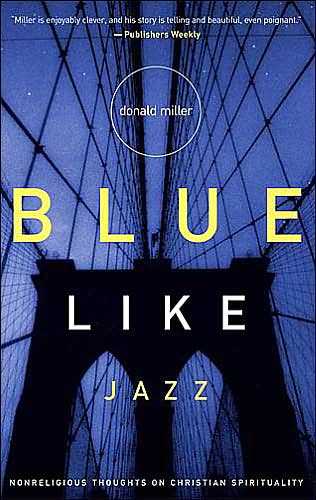 Well, I have been a little blue for a couple of days, but that's not what I mean. To be really accurate about my moods, I guess I'd say I've been purple or orange or something with a little more aggression than blue. But that's not what I'm blogging about.
I'm about three years behind in this endeavor, but I'm finally reading Blue Like Jazz. Mr. Incredible reminds me that it's a collegey book (and I am sooo past that, right?) . . . but frankly I'm feeling like I might have skipped some of the developmental stages that the average Christian college student goes through, so I've got some things to catch up on.
First off, any non-fundamentalist who begins a book talking about the depravity of humankind is going to get my attention. That's just the way it is.*
The genius of Don's opening chapters--and indeed, his own experience of coming to faith--is that he identified a problem (human depravity, the broken state of things here on Earth), and it was working from this problem that he found a solution.
Some old Brethren in Christ people would probably be very pleasantly surprised by Don's talk about sin and depravity--the kinds of things, my boss mentioned recently, "that aren't preached anymore." Well, I don't know about that. The word "sin" is in little danger of going extinct at Dillsburg, but according to her this concept that we're fallen--that "what I do is not the good I want to do; no, the evil I do not want to do—this I keep on doing"--is falling out of favor with Evangelicals.
What really struck me as I read was that I've read so many people say they discovered God in nature--something I resonate with, as it's always been particularly easy for me to see Him in His creation--but I've never really heard anyone detail their natural discovery of coming to understand what sin and brokenness are by looking at the world around them. Don writes,
. . . I knew, because of my own feelings, there was something wrong with me, and I knew it wasn't only me. I knew it was everybody. It wasn't on the skin; it was on the soul. . . . It was as if we were broken, I thought, as if we were never supposed to feel these sticky emotions. It was as if we were cracked, couldn't love right, couldn't feel good things for very long without screwing it all up.
And if we don't realize this, what will God and His grace mean to us? If there is no question; no problem, there is no need for an answer; a solution.
*For all I know, Miller--no, I think I'll call him "Don" to match the casual tone of his book--might go on to completely undermine the foundation he's built in these opening chapters. But I'll just have to wait to find out.
**Edited for clarity 12.06.06 8:50 a.m.
Friday, November 10, 2006
Rich
If you believe the U.N., Norway is the best place on earth to live. Their literacy rate, healthcare, income, and education levels all soar above most other nations, making Norwegians some of the healthiest and wealthiest people in the world.
But maybe not the most blessed.
Apparently, even with all of those wonderfully high living conditions, they seem to be quite the whiny lot, and are at a bit of a loss to find solutions for their crowded healthcare system (which, though they complain about it, allows them to live some of the longest lives on the planet).
 I watched a short film yesterday called Rich, featuring Rob Bell of Mars Hill. I've seen quite a few of these nooma films, and I really appreciate their thoughtful, fresh, artful approach to the Christian faith.
I liked this one, too, but one thing really stuck in my mind:
 However, I'm intrigued by what "the best place to live" and "blessed" really mean to the U.N. and to Rob Bell--and to the rest of us. The world's most healthy and comfortable nations (again, according to the U.N.) are Norway, Australia, Ireland, Sweden, Canada, Japan, and the United States. Yet the people living in each of these nations are some of the unhappiest--and most secular--on earth.
Rob Bell looks around at America and says, "We are blessed."
I'm not looking at statistics here, but it seems to me that materially, yes--we are. But the Church in our corner of the world is diseased, and spiritually, its people are starving and naked. When I look at the Church in the rest of the world, I see people who have learned to trust in God for their next meal; to serve Him despite violent consequences; to worship Him joyfully; and to live contentedly in community.
Yes, I know that is a bit of a rose-colored view of the global Church. I know it is not all like that. But it seems to me that what many call blessing is actually a curse.
A curse, interestingly enough, that we are supposed to share with the rest of the world. I have been told so many times that
 Because "it is easier for a camel to go through the eye of a needle than for a rich man to enter the kingdom of God," I must conclude that our wealth, our comfort, and our abundance are not necessarily a blessing. Wealth is probably not inherently good or bad, but combined with our human nature, it can be toxic to our spiritual well-being. With this knowledge, we must be very careful not to recklessly dump our wealth on the poor; so in fact our responsibility as rich Christians is that much heavier.
Not only must we be generous and compassionate, but we are also called to help the recipients of our gifts to keep from becoming as apathetic, faith-less, and enamored with the things of this world as we are.
Otherwise, we're just playing a global game of hot potato with the hazardous material of wealth.
I don't envy the poor. I never wanted to live in a war-ravaged land led by tyrants who starve their people. I don't want my children to wear rags. I just think we should remember that God draws near to the poor--and it is, perhaps, easier for the poor to draw near to Him. But they are blessed. Jesus said so.
As for those of us who eat three (or four) meals a day and sleep in comfortable beds . . . I'm not quite so sure.
All I know is that we have work to do, and we better be prayerful, careful, and quick about it.
But maybe not the most blessed.
Apparently, even with all of those wonderfully high living conditions, they seem to be quite the whiny lot, and are at a bit of a loss to find solutions for their crowded healthcare system (which, though they complain about it, allows them to live some of the longest lives on the planet).
 I watched a short film yesterday called Rich, featuring Rob Bell of Mars Hill. I've seen quite a few of these nooma films, and I really appreciate their thoughtful, fresh, artful approach to the Christian faith.
I liked this one, too, but one thing really stuck in my mind:
I see these bumper stickers that say, "God bless America," and I think, "God has blessed America."The film goes on to remind viewers that our world--the world in which most of us have cars (even if they're crappy) and have enough to eat each day--is not the world. I grew up hearing this just about every day, and I think it's something we all need to realize. People everywhere are starving, dying of diseases that are totally and completely curable, and by and large that is not our reality here in North America. Therefore, we have the great freedom--and responsibility--to share what we have in order to feed, clothe, and give shelter to the poor around the world. Of that I am certain.
 However, I'm intrigued by what "the best place to live" and "blessed" really mean to the U.N. and to Rob Bell--and to the rest of us. The world's most healthy and comfortable nations (again, according to the U.N.) are Norway, Australia, Ireland, Sweden, Canada, Japan, and the United States. Yet the people living in each of these nations are some of the unhappiest--and most secular--on earth.
Rob Bell looks around at America and says, "We are blessed."
I'm not looking at statistics here, but it seems to me that materially, yes--we are. But the Church in our corner of the world is diseased, and spiritually, its people are starving and naked. When I look at the Church in the rest of the world, I see people who have learned to trust in God for their next meal; to serve Him despite violent consequences; to worship Him joyfully; and to live contentedly in community.
Yes, I know that is a bit of a rose-colored view of the global Church. I know it is not all like that. But it seems to me that what many call blessing is actually a curse.
A curse, interestingly enough, that we are supposed to share with the rest of the world. I have been told so many times that
- I am evil because I have too much stuff and my luxury is at the expense of the poor.
- Poor people around the world are righteous and will inherit the Kingdom.
- I should give poor people my stuff because I have too much and they don't have anything.
If we rich Americans give away all our stuff, poor people will now be rich (and therefore as spiritually destitute as we currently are), which is no better than the current state of things.
 Because "it is easier for a camel to go through the eye of a needle than for a rich man to enter the kingdom of God," I must conclude that our wealth, our comfort, and our abundance are not necessarily a blessing. Wealth is probably not inherently good or bad, but combined with our human nature, it can be toxic to our spiritual well-being. With this knowledge, we must be very careful not to recklessly dump our wealth on the poor; so in fact our responsibility as rich Christians is that much heavier.
Not only must we be generous and compassionate, but we are also called to help the recipients of our gifts to keep from becoming as apathetic, faith-less, and enamored with the things of this world as we are.
Otherwise, we're just playing a global game of hot potato with the hazardous material of wealth.
I don't envy the poor. I never wanted to live in a war-ravaged land led by tyrants who starve their people. I don't want my children to wear rags. I just think we should remember that God draws near to the poor--and it is, perhaps, easier for the poor to draw near to Him. But they are blessed. Jesus said so.
As for those of us who eat three (or four) meals a day and sleep in comfortable beds . . . I'm not quite so sure.
All I know is that we have work to do, and we better be prayerful, careful, and quick about it.
Saturday, October 21, 2006
You can't just let it go to waste
The other day, I made a salad. A darn good one, too--it's a Willow Cottage specialty--spring greens, small chunks of sharp cheddar cheese, dried cranberries, Granny Smith apples, walnuts, and raspberry vinaigrette. But I only needed half of the apple, and seeing as I wasn't in the mood for the mouth-puckering sensation of eating a Granny Smith all by itself, and had no other designs for this crisp apple half . . . it went to waste.
I could have just worked it into some recipe somehow; I've got lots of other kinds of apples sitting around, and I'm sure I could have baked up an apple pie or crisp or whatever. But we don't need any more food, and Mr. Wonderful and I aren't exactly eager to say to each other, "well, there's just more of you to love."
As I was scolding myself about my poor stewardship of this crisp, beautiful apple--and the many other things that I throw out each month--I felt sad.
Because it's not as if stuffing more food down my throat--or anyone else's--is going to alleviate the hunger of starving children across the world. And I couldn't very well send that half an apple to a kid in Zimbabwe, could I? That's the trouble: if the food is already here, sitting on the shelves of my local supermarket, it's either going to be eaten here in North America by people who have plenty of food, or it's going in the compost heap.
If I have food, but don't know what to do with it, and I eat it just to make sure it doesn't go to waste (not because I'm hungry), I am doing nothing to alleviate world hunger or even being a good steward of the resources I have. I am simply assuaging my conscience, and getting fatter while I'm at it. And that definitely isn't good stewardship, either.
So then I thought, maybe I shouldn't have bought the apple in the first place; if I didn't know what to do with the whole thing, that was probably a bad consumer choice. And that's probably true. But then, if I become really careful about what I buy, purchasing the minimum amount of food possible, aren't I making it more difficult for hard-working farmers to make a living?
There's a veggie stand a couple of miles away that I like to buy from, not so much because the food is good, but because the older couple that runs it looks like they could use the money to supplement their meager Social Security checks each month.
Anyway, if I leave the apple in the bin at the store or the fruit stand, it's not like that suddenly frees up food to be sent elsewhere.
But food does get sent to the world's hungriest places--I know that, and I want to support it as much as possible. But world hunger is not the result of a global food shortage; grain is regularly dumped in the ocean to regulate prices. Nor is it the direct result of obese North Americans hogging and wasting all the food. The trouble is that some governments are determined to starve their people, and won't accept aid--and that we don't work hard enough to move the food supply where it really needs to be (instead of, say, dumping it in an ocean, it would be nice if we could ship it across an ocean . . . but then, it still might be rejected).
In the grand scheme of things, maybe I should be less concerned with throwing out a half of an apple than with my failure to change the systems that withhold food from the people who really need it.
Wasting food is a nice, tidy kind of sin to commit. But it's only a front--a distraction--from the great omission.
I could have just worked it into some recipe somehow; I've got lots of other kinds of apples sitting around, and I'm sure I could have baked up an apple pie or crisp or whatever. But we don't need any more food, and Mr. Wonderful and I aren't exactly eager to say to each other, "well, there's just more of you to love."
As I was scolding myself about my poor stewardship of this crisp, beautiful apple--and the many other things that I throw out each month--I felt sad.
Because it's not as if stuffing more food down my throat--or anyone else's--is going to alleviate the hunger of starving children across the world. And I couldn't very well send that half an apple to a kid in Zimbabwe, could I? That's the trouble: if the food is already here, sitting on the shelves of my local supermarket, it's either going to be eaten here in North America by people who have plenty of food, or it's going in the compost heap.
If I have food, but don't know what to do with it, and I eat it just to make sure it doesn't go to waste (not because I'm hungry), I am doing nothing to alleviate world hunger or even being a good steward of the resources I have. I am simply assuaging my conscience, and getting fatter while I'm at it. And that definitely isn't good stewardship, either.
So then I thought, maybe I shouldn't have bought the apple in the first place; if I didn't know what to do with the whole thing, that was probably a bad consumer choice. And that's probably true. But then, if I become really careful about what I buy, purchasing the minimum amount of food possible, aren't I making it more difficult for hard-working farmers to make a living?
There's a veggie stand a couple of miles away that I like to buy from, not so much because the food is good, but because the older couple that runs it looks like they could use the money to supplement their meager Social Security checks each month.
Anyway, if I leave the apple in the bin at the store or the fruit stand, it's not like that suddenly frees up food to be sent elsewhere.
But food does get sent to the world's hungriest places--I know that, and I want to support it as much as possible. But world hunger is not the result of a global food shortage; grain is regularly dumped in the ocean to regulate prices. Nor is it the direct result of obese North Americans hogging and wasting all the food. The trouble is that some governments are determined to starve their people, and won't accept aid--and that we don't work hard enough to move the food supply where it really needs to be (instead of, say, dumping it in an ocean, it would be nice if we could ship it across an ocean . . . but then, it still might be rejected).
In the grand scheme of things, maybe I should be less concerned with throwing out a half of an apple than with my failure to change the systems that withhold food from the people who really need it.
Wasting food is a nice, tidy kind of sin to commit. But it's only a front--a distraction--from the great omission.
Friday, September 29, 2006
Ahh, Lewisberry [part two]
 On trash day in Lewisberry, pizza boxes jut boldly out of trash cans waiting to be taken to their final destination. Their inflexible corners stretch black trash bags beyond their limit, leaving holes and issuing an invitation to all prowling creatures: come and get it.
If Lewisberry has an official food, it's the pie of all pies that's not really a pie. With one pizzeria for every 29.2 households, tomato sauce and extra sausage are the bread and butter of this community.
I'll never forget the first pizza I ever ordered as a Lewisberrian. It was a chilly, damp evening in late March, and my shoes were covered in the soggy wallpaper bits I'd been tearing off the walls of our new home (goodbye cabbage roses and stripes; hello taupe #04).
 When they're not grabbing a pizza--or one of Rock-It Pizza's famous cheesesteaks that take the average eater three days to consume--Lewisberrians grill. It is never too cold, too blustery, or even too rainy to grill, and the aromas of hickory and lightly charred chicken fill the streets almost every weekend.
The Silver Lake Inn--which just reopened in July--runs specials like "25-cent wing night" and "all you can eat shrimp," but as I haven't yet visited that curiously decorated venue, I have little to say about it except that it scares me to death.
For the budget- and nutrition-conscious who cannot live on pizza and ribs alone, there's the Manorette--L.H. Gross Manorette, to be precise--which carries a surprisingly large variety of lard products and canned beans in bulk. The Manorette (well, actually, the locals usually call it "Gross's") is also the perfect place to pick up the essentials--cigarettes, lottery tickets, chewing tobacco, and ice cream.
 I stop by the Manorette once a month or so, usually in somewhat of a frenzy because I've already started dinner or baking cookies, and just realized we're out of some staple ingredient like eggs, milk, or cumin. I've never fit in well at the Manorette; all the other customers and employees know each other "from way back," and I'm just a newbie. I wouldn't even be suprised if they see me as a yuppie, because in comparison to them, I am. Owing to my aversion to NASCAR t-shirts and mullets, I don't look like them, and since we didn't go to high school together, the Manorette's customers and employees and I don't have much of a connection.
Or at least, we didn't--until last week, when I was actually engaged in conversation by a customter and employee who recognized me as "the woman who walks her dog all the time in any kind of weather."
And now, I'm finally a Lewisberrian.
[Note: Images added 12.19.2006]
To be continued . . .
Thursday, September 21, 2006
Ahh, Lewisberry [part one]

Most people know it as the home of the only half-decent downhill ski resort in the area, which makes use of the unusually high hills and ridges that are so characteristic of Lewisberry. Rising high above the valleys surrounding the Susquehanna River and Yellow Breeches Creek, Lewisberry’s heights (which should not be confused with
From my house, I have a wonderful view of those heights—which, of course, is because I’m not on them. We live in the rain gutter—I mean, valley—of Lewisberry, where mist descends on an almost daily basis, shrouding the rippling fields and farms in mystery. It’s on account of the mist that Lewisberry mornings are so ethereal—a word that one could never use to describe Lewisberry at any other time of day.
On cool, damp mornings, when we gaze out over our back fence, beyond mist-blanketed crops of soybeans and corn, a line of distant trees are silhouetted against the tangerine sunrise. On mornings like these, Lewisberry seems a very philosophical town—one cannot help but think lofty thoughts when driving through the peach mist on the way to work.
And then there are afternoons. And they’re not philosophical at all.
To be continued . . .
Thursday, August 24, 2006
On editing
 She was a middle-aged woman, slightly pudgy around the edges, with a critical air about her. Her dark-rimmed glasses rested just where she wanted them on her nose, and her clothes, though soft and simple, had been carefully and particularly selected.
Leaning in toward the round dinner table so she could be heard above the conference din, she pronounced with a knowing smile, "You're an editor, aren't you?"
"Why yes." I probably didn't actually say it quite like that, but it's my story and I get to write it however I want to.
Her co-worker, who sat next to her, looked astonished. "How did you know that?" she demanded.
I was about to answer that perhaps she had read my nametag, since it seemed to give away just about all the details of my life, when the first woman answered.
"We editors are born."
Feeling that I had just been linked to some sort of elite editing aristocracy, I shifted uncomfortably and changed the subject.
Was I carrying a red pen, or correcting someone's word choice? What was it that gave me away? After all, I wouldn't necessarily consider myself a good editor. But she could tell.
Later that night, I got to thinking, and it seems there is something about me--call it perfectionism, being anal retentive, whatever--that is a huge asset to me as an editor. I'm very particular, and each time I miss the mark, I try again--harder--to improve.
But that impulse is not unique to editors. In fact, I think that as a follower of Christ, I'm called to be an editor--to humbly approach and revisit my life, each day making choices that are closer to what God wants them to be.
So in that sense, yes, I was born an editor. But then, so was everybody else.
Wednesday, June 14, 2006
The trouble with men
 Ahh, caught your attention with that line, didn't I? I love it that you're sitting here, reading "the trouble with men" and asking yourself in shock, "what overgeneralized, politically-incorrect thing is she about to say about men?" Well, I'll try not to overgeneralize, but since I don't care so much about being politically correct, maybe you'll find at least a hint of shock value in this post after all.
I've been concerned for quite a few years about men. Why is it that they're not going to college? Taking so long to grow up (or not growing up at all)? Moving back in with their parents? Drowning in alcohol? Not taking ownership of their jobs, homes, families, or churches? And maybe most alarmingly, why don't young men have bigger dreams and ambitions--and why aren't they striving toward them?
I consider myself one of the lucky few 20-something women who have found a good Generation Y man. In fact, I even laugh when I think about calling the majority of Generation Y males "men"; they're not yet deserving of that mature term. Instead, they're stuck in guyhood, and it doesn't look like they'll emerge anytime soon.
Some people say they know the reasons. Maybe they do. Boundless is currently running an interesting article by Dr. Albert Mohler, who's discussing the implications modern masculinity is having on television and vice-versa.
His article begins:
In the film adaptation of Chuck Palahniuk's violent novel, Fight Club, character Tyler Durden points to his generation of young men as the "middle children of history." Played by actor Brad Pitt, Durden represents the absolute collapse of masculinity into raw violence. This character joins his friends in seeking personal release and ecstasy through violent fights that send the participants regularly to the emergency room. In a haunting comment, Durden remarks: "We are a generation of men raised by women." Is this our future?His article goes on to make some interesting (but overly simplistic) observations about and explanations for the antisocial, morally ambiguous characters that young males prefer to watch on TV these days (although of course, I think I probably prefer these characters, too, so what does that say about me?).
But what really strikes me is the phrase "a generation of men raised by women." If there is a problem with modern masculinity, could it be that men have not benefited from role models of the same gender--men who could teach them how to be men?
The world is increasingly run by women. It seems that we have a particularly strong drive to prove ourselves, go above and beyond, and to put ourselves in places of power to effect change where we see injustices and unfinished work. The thing is, as women have begun to enter the professional and church realms as leaders--which is wonderful--men don't seem to see the need to compete. Furthermore, businesses are increasingly valuing stereotypically feminine characteristics, like emotional sensitivity and non-confrontational personalities, rather than the aggressive, assertive qualities they were looking for 40 years ago. Is there anything inherently wrong with that?
No, not really.
But the thing is that if our society undervalues men, and men are not receiving mentoring and training from fathers and older men, young men will increasingly find themselves detached and lonely, wondering where they fit--or if they fit at all. Because, after all, even if they were raised by women, they still can't be women. They weren't meant to be, and society shouldn't expect them to be.
With all these odds stacked against them, it's really no wonder that they have no dreams or goals, and that their heroes are flawed and aimless; what, really, does the women's world have to offer them?
Friday, June 09, 2006
The truth
Sorry I haven't made much of an appearance this week . . . my achy breaky back has been giving me grief all week, and most things (like laundry, vacuuming, blogging, and working outside) have fallen by the wayside. But I'm determined to get better soon--preferably before I run out of clean laundry and things start growing in the carpet.
But enough about me . . . let's talk about the Internet. :)
I guess it was all too good to be true--the unbounded freedom of speech with the power to reach the masses. At some point, somebody would try--really, really hard--to lock down and censor the Internet. I've known for a while that the Internet the Chinese people see is not the same as the one delivered to my browser each day, and there are certain websites they'll never be able to see.
But somehow, this was the last straw for me. I think it's because I don't know how I would live or think without Google--it always delivers just what I need to know (and of course, lots that I don't need to know) just when I need it. You have to sort through it, but the truth is out there, and Google makes it easy to do that.
I know everybody's mad at Google for giving in to to their wallets and turning a blind eye to intense Chinese censorship, and I guess it makes me mad to a certain extent, but maybe I don't expect companies to live so much on values--last time I checked, companies' actions were mostly dictated by supply and demand. And boy, is there demand for a censored Internet.
And it's this demand that infuriates me. Injustice covers our planet like kudzu in the Southeast, choking out life and forming thick screens so that as far as you can see, injustice is just about the only thing in sight. And I know many people blame greed and prejudice--and certainly, they are fuel for war and inequality.
But I think the worst kind of injustice comes from being deceived about the truth. When Chinese people don't have access to information about Tiananmen Square, that's wrong--and they may never know the truth.
I don't know who to blame for this (The media? My upbringing? I don't know.) but there was a time when I was completely unaware of the fact that Saddam Hussein had massacred thousands of his people. Growing up during the Gulf War, you'd think I would have known, but it wasn't talked about, because everyone had decided the war was about oil and profit, and who knows what else. And maybe it was. But when everyone was debating the war then (and later, the war in Iraq) I never heard anyone mention the tyranny of the Iraqi people. And believe what you may about Saddam and the wars, don't you think it's helpful to know whether or not he was a mass murderer? You can still choose not to go to war against him, but you still need to tell the truth about him.
The Chinese government knows that if its people knew the complete truth, they would revolt. So they lie, censor, and cover things up. I know that, as humans, we have rights to certain standards of treatment. And I'm wondering why truth isn't one of our rights. Don't we have the right to know the truth? Deception and censorship can truly be just as inhumane as torture and abuse; they allow powerful people to use those below them as misinformed pawns in their mighty games of control. Even if I were living under a tyrannical government structure, and had absolutely no power to escape or overthrow it, I would expect to know the truth.
Because ultimately, the truth will set you free.
But enough about me . . . let's talk about the Internet. :)
I guess it was all too good to be true--the unbounded freedom of speech with the power to reach the masses. At some point, somebody would try--really, really hard--to lock down and censor the Internet. I've known for a while that the Internet the Chinese people see is not the same as the one delivered to my browser each day, and there are certain websites they'll never be able to see.
But somehow, this was the last straw for me. I think it's because I don't know how I would live or think without Google--it always delivers just what I need to know (and of course, lots that I don't need to know) just when I need it. You have to sort through it, but the truth is out there, and Google makes it easy to do that.
I know everybody's mad at Google for giving in to to their wallets and turning a blind eye to intense Chinese censorship, and I guess it makes me mad to a certain extent, but maybe I don't expect companies to live so much on values--last time I checked, companies' actions were mostly dictated by supply and demand. And boy, is there demand for a censored Internet.
And it's this demand that infuriates me. Injustice covers our planet like kudzu in the Southeast, choking out life and forming thick screens so that as far as you can see, injustice is just about the only thing in sight. And I know many people blame greed and prejudice--and certainly, they are fuel for war and inequality.
But I think the worst kind of injustice comes from being deceived about the truth. When Chinese people don't have access to information about Tiananmen Square, that's wrong--and they may never know the truth.
I don't know who to blame for this (The media? My upbringing? I don't know.) but there was a time when I was completely unaware of the fact that Saddam Hussein had massacred thousands of his people. Growing up during the Gulf War, you'd think I would have known, but it wasn't talked about, because everyone had decided the war was about oil and profit, and who knows what else. And maybe it was. But when everyone was debating the war then (and later, the war in Iraq) I never heard anyone mention the tyranny of the Iraqi people. And believe what you may about Saddam and the wars, don't you think it's helpful to know whether or not he was a mass murderer? You can still choose not to go to war against him, but you still need to tell the truth about him.
The Chinese government knows that if its people knew the complete truth, they would revolt. So they lie, censor, and cover things up. I know that, as humans, we have rights to certain standards of treatment. And I'm wondering why truth isn't one of our rights. Don't we have the right to know the truth? Deception and censorship can truly be just as inhumane as torture and abuse; they allow powerful people to use those below them as misinformed pawns in their mighty games of control. Even if I were living under a tyrannical government structure, and had absolutely no power to escape or overthrow it, I would expect to know the truth.
Because ultimately, the truth will set you free.
Wednesday, May 03, 2006
Sit back and watch the show
An article I wrote about a year and a half ago, which appeared in Relevant magazine online. Read it below or on Relevant's site.
 I pop a very familiar videotape into the VCR and collapse on the couch. About once a year, while curled up under a pile of blankets in an attempt to recover from a bad cold or the latest bug that’s going around, I watch The Princess Bride. When the gray lines of overuse began to creep up the screen, I considered upgrading to a DVD copy, complete with special features, but at this point, it would feel like throwing out my favorite teddy bear when his stuffing began to leak out. No matter how many times I watch it, the corny lines, “No more rhymes now; I mean it … Anybody want a peanut?” still make me chuckle. But these days, I don’t always watch the whole film all at once. When I’m aching for a healthy dose of laughter, I’ve been known to simply fast-forward to my favorite scenes (such as the duel atop the Cliffs of Insanity). It’s not that I don’t like the rest of the movie; I’m just anxious to watch the next high point of this familiar comedy.
Movies aren’t the only things through which I like to fast-forward. In my life, the grass has always been greener in the future. I spent much of my childhood practicing to be a teenager and most of my teen years longing for my driver’s license. But, of course, when my 16th birthday rolled around, the keys to the car were only a fleeting source of happiness, as my gaze was now fixed on another milestone in the future. College, I thought, was where I could truly come alive as an intellectual and as an adult (naïve, I know). Milestone after milestone was reached and forgotten, as I grasped further into the future, in search of a fully satisfied life. My longing for the future became much like a cycle of consumerism—no accomplishment was ever enough to satisfy me; I always wanted something more. When I graduate, everything will be fine, I thought. Life’s hard now, but things will be easier when I get married.
Marriage and college graduation are two of my proudest accomplishments in the past few years. But as I look back, I realize that my gaze has been so fixed on each goal that much of the months and days in between have become a blur. I was living life in fast-forward, just getting by until I reached the next summit. By focusing so intently on the future, I was not allowing God to use me in the here and now. I viewed the present as nothing but a path to the future that must be endured, thereby cutting myself off from any joy that could be found along the way.
There’s little enjoyment to be found in fast-forwarding through a movie you’ve never seen before. You don’t know where the best scenes are, so you can’t tell when to press “play.” And even if you were to come across one of the film’s best scenes, it wouldn’t make much sense if you hadn’t invested time getting to know each character and situation. Taken out of its context, the most moving or knee-slapping cinematic moment can be absolutely meaningless.
Graduating from college is not inherently significant. It is only in light of the long hours I spent reading one page of Derrida’s philosophy and the tears that were shed over a Medieval-Renaissance research paper that my diploma means anything to me. My wedding day was only a joyous occasion because of the man I had grown to love—and such a deep, committed relationship does not spring up overnight. It takes time, effort and even some pain, but it is only through these things that we experience pure joy.
After decades of insulating himself from the pain of loss, C.S. Lewis’ character in the 1993 film Shadowlands comes to a similar conclusion. When he finally opens himself up to give and receive love, he does it with the knowledge that he is eventually going to lose his wife to cancer. Whether their time together on earth will last weeks or years, he doesn’t know—but he realizes that he will ultimately experience the deepest sorrow he has ever known. After his wife, Joy, dies, he finally allows himself to live with his grief, acknowledging that “the pain now is part of the happiness then [in Heaven].”
This is not to say, however, that we should wallow in our misery, never allowing ourselves to long for the future. We are a homesick people, waiting to be taken to our Father’s house! And though we grow weary of all the pain and toil we experience here on earth, we cannot fast-forward through the difficult moments of life. We ought to challenge ourselves to be like Paul, who said, “I have learned the secret of being content in any and every situation, whether well fed or hungry, whether living in plenty or in want” (Philippians 4:12).
How I would love to say that I, too, have learned the “secret” Paul speaks of! But I think that one component of this secret is found in his next sentence: “I can do everything through him who gives me strength” (Philippians 4:13). Because Paul has a profound trust that God will strengthen him to withstand any kind of trial, he can face each day with joy.
Trusting God isn’t one my strong points (just ask my husband; he is constantly reminding me to do so!), but He is the only one who is completely worthy of my trust. I may not always enjoy each step along the journey, but with God in control, I can be confident that He is using each experience to make me holy. So, I’ll shakily hand Him the remote, sit back and watch the show.
 I pop a very familiar videotape into the VCR and collapse on the couch. About once a year, while curled up under a pile of blankets in an attempt to recover from a bad cold or the latest bug that’s going around, I watch The Princess Bride. When the gray lines of overuse began to creep up the screen, I considered upgrading to a DVD copy, complete with special features, but at this point, it would feel like throwing out my favorite teddy bear when his stuffing began to leak out. No matter how many times I watch it, the corny lines, “No more rhymes now; I mean it … Anybody want a peanut?” still make me chuckle. But these days, I don’t always watch the whole film all at once. When I’m aching for a healthy dose of laughter, I’ve been known to simply fast-forward to my favorite scenes (such as the duel atop the Cliffs of Insanity). It’s not that I don’t like the rest of the movie; I’m just anxious to watch the next high point of this familiar comedy.
Movies aren’t the only things through which I like to fast-forward. In my life, the grass has always been greener in the future. I spent much of my childhood practicing to be a teenager and most of my teen years longing for my driver’s license. But, of course, when my 16th birthday rolled around, the keys to the car were only a fleeting source of happiness, as my gaze was now fixed on another milestone in the future. College, I thought, was where I could truly come alive as an intellectual and as an adult (naïve, I know). Milestone after milestone was reached and forgotten, as I grasped further into the future, in search of a fully satisfied life. My longing for the future became much like a cycle of consumerism—no accomplishment was ever enough to satisfy me; I always wanted something more. When I graduate, everything will be fine, I thought. Life’s hard now, but things will be easier when I get married.
Marriage and college graduation are two of my proudest accomplishments in the past few years. But as I look back, I realize that my gaze has been so fixed on each goal that much of the months and days in between have become a blur. I was living life in fast-forward, just getting by until I reached the next summit. By focusing so intently on the future, I was not allowing God to use me in the here and now. I viewed the present as nothing but a path to the future that must be endured, thereby cutting myself off from any joy that could be found along the way.
There’s little enjoyment to be found in fast-forwarding through a movie you’ve never seen before. You don’t know where the best scenes are, so you can’t tell when to press “play.” And even if you were to come across one of the film’s best scenes, it wouldn’t make much sense if you hadn’t invested time getting to know each character and situation. Taken out of its context, the most moving or knee-slapping cinematic moment can be absolutely meaningless.
Graduating from college is not inherently significant. It is only in light of the long hours I spent reading one page of Derrida’s philosophy and the tears that were shed over a Medieval-Renaissance research paper that my diploma means anything to me. My wedding day was only a joyous occasion because of the man I had grown to love—and such a deep, committed relationship does not spring up overnight. It takes time, effort and even some pain, but it is only through these things that we experience pure joy.
After decades of insulating himself from the pain of loss, C.S. Lewis’ character in the 1993 film Shadowlands comes to a similar conclusion. When he finally opens himself up to give and receive love, he does it with the knowledge that he is eventually going to lose his wife to cancer. Whether their time together on earth will last weeks or years, he doesn’t know—but he realizes that he will ultimately experience the deepest sorrow he has ever known. After his wife, Joy, dies, he finally allows himself to live with his grief, acknowledging that “the pain now is part of the happiness then [in Heaven].”
This is not to say, however, that we should wallow in our misery, never allowing ourselves to long for the future. We are a homesick people, waiting to be taken to our Father’s house! And though we grow weary of all the pain and toil we experience here on earth, we cannot fast-forward through the difficult moments of life. We ought to challenge ourselves to be like Paul, who said, “I have learned the secret of being content in any and every situation, whether well fed or hungry, whether living in plenty or in want” (Philippians 4:12).
How I would love to say that I, too, have learned the “secret” Paul speaks of! But I think that one component of this secret is found in his next sentence: “I can do everything through him who gives me strength” (Philippians 4:13). Because Paul has a profound trust that God will strengthen him to withstand any kind of trial, he can face each day with joy.
Trusting God isn’t one my strong points (just ask my husband; he is constantly reminding me to do so!), but He is the only one who is completely worthy of my trust. I may not always enjoy each step along the journey, but with God in control, I can be confident that He is using each experience to make me holy. So, I’ll shakily hand Him the remote, sit back and watch the show.
Subscribe to:
Posts (Atom)